Vandaag in alle vroegte op pad. Voor het mooie licht moet je de eerste uurtjes na zonsopkomst pakken. Dat is nog geen garantie voor mooie foto's. Als het licht is zie je bijvoorbeeld een Purperreiger al moeilijk zitten laat staan in het donker of in de schemer. Vanochtend vlogen ze me letterlijk om de oren vanuit de sloot terwijl ik nog aan het fietsen was. Hier vliegt er eentje weg in de verte tegen de opkomende zon.
--------------------------------------------------------------------------------------------
Today I'm off before dawn. To catch the best light you have to be out for the first hours after sunrise. This doesn't guarantee great pictures. A Purple Heron for example is hard enough to spot in the field when there is enough light, it's even harder in the dark. This morning they flew up from everywhere around me while I was cycling to my destination. Here is one flying into the rising sun.
Today I'm off before dawn. To catch the best light you have to be out for the first hours after sunrise. This doesn't guarantee great pictures. A Purple Heron for example is hard enough to spot in the field when there is enough light, it's even harder in the dark. This morning they flew up from everywhere around me while I was cycling to my destination. Here is one flying into the rising sun.
 |
| Purperreiger bij zonsopkomst |
En vandaag besluiten ze allemaal tegen het licht te vliegen, lastig vast te leggen...
--------------------------------------------------------------------------------------------
And they all decide to fly into the sun today, hard to capture...
And they all decide to fly into the sun today, hard to capture...
 |
Purperreiger Purple Heron - Ardea purpurea
|
In de verte zie ik een Reebok de plas oversteken. Ik zag hem te laat, hij was inmiddels bijna de hele plas overgestoken. Ik heb dit wel vaker gezien hier, blijkbaar is het verse gras aan de overkant de moeite waard om een nat pak te halen. Reeën kunnen uitstekend zwemmen, al aarzelt deze even alvorens het diepe in te stappen.
--------------------------------------------------------------------------------------------
In the distance I see a Roe Deer buck crossing the lake. I saw it too late as it had already crossed the biggest part. I've seen this before here, clearly the grass on the other side must be worth getting wet. Roe Deer are excellent swimmers, even though this one hesitates for a moment before stepping into the deeper part of the lake.
In the distance I see a Roe Deer buck crossing the lake. I saw it too late as it had already crossed the biggest part. I've seen this before here, clearly the grass on the other side must be worth getting wet. Roe Deer are excellent swimmers, even though this one hesitates for a moment before stepping into the deeper part of the lake.
 |
| Ree - Roe Deer - Capreolus capreolus |
Vaste bezoeker ieder jaar is de Tapuit. Dit keer een vrouwtje. Ze overwinteren op de afrikaanse savanne en in het voorjaar vindt je ze weer in Nederland op schaars begroeide plekken met voldoende insecten, laag bij de grond, waar ze ook broeden. Het zijn holenbroeders, ze broeden vaak in konijnenholen. Door verlies van habitat zie je ze steeds minder vaak in ons land. Begin jaren 70 nog 2000-3000 paar, in 2000 nog maar 600 tot 800 paar, waarvan de meeste in de duingebieden.
--------------------------------------------------------------------------------------------
A regular visitor each year is the Wheatear. This time it's a female. They are summer visitors and migrants which spend the winter on the african savanna. You can find them here in areas with scarce vegetation and plenty of insects, low to the ground, were they also breed. They often nest in Rabbit holes. Caused by loss of habitat you see them less these days. In the 70's there were 200 to 3000 pair in the year 2000 only 600 to 800 breeding couples were counted. Most of them in the dunes along the coastline.
A regular visitor each year is the Wheatear. This time it's a female. They are summer visitors and migrants which spend the winter on the african savanna. You can find them here in areas with scarce vegetation and plenty of insects, low to the ground, were they also breed. They often nest in Rabbit holes. Caused by loss of habitat you see them less these days. In the 70's there were 200 to 3000 pair in the year 2000 only 600 to 800 breeding couples were counted. Most of them in the dunes along the coastline.
 |
Tapuit - Northern Wheatear - Oenanthe oenanthe
|
 |
Van de Blauwborst is, zoals bij veel vogels het mannetje het mooist. Hier een vrouwtje. Die zie je niet zo vaak omdat ze zich meestal verschuilen in het riet en omdat ze goed gecamoufleerd zijn, handig als je op het nest zit om eieren uit te broeden Je kunt nog net de vage tekening op de borst zien die bij de mannetjes zo opvallend blauw en rood is met een witte 'ster'.
--------------------------------------------------------------------------------------------
Like in many other bird species, the male Bluethroat is the most beautiful. This is a female, which you rarely get to see because they stay low in the reed and are well camouflaged. Convenient when you're on the nest breeding. You can vaguely recognize the blue and red colors on the breast which is so striking on the male.
Like in many other bird species, the male Bluethroat is the most beautiful. This is a female, which you rarely get to see because they stay low in the reed and are well camouflaged. Convenient when you're on the nest breeding. You can vaguely recognize the blue and red colors on the breast which is so striking on the male.
 |
| Blauwborst (v) - Bluethroat (f) - Luscina svecica |
Een familie Grauwe ganzen waggelt langzaam op me af. Meestal vliegen ze luidkeels weg, maar nu ze kuikens hebben blijven ze op de grond om hun kroost te verdedigen. De ouder vogels speuren alert de omgeving af en houden vooral ook het luchtruim goed in de gaten want hier vliegen Bruine kiekendieven, Haviken, Sperwers, en Buizerds rond. Ook Vossen zijn gevaarlijke vijanden voor de kwetsbare jongen. Bij gevaar verstoppen de kuikens zich in de begroeiing.
--------------------------------------------------------------------------------------------
A family of Greylag Geese slowly approaches me. Mostly they'll fly away protesting loudly, but now they have chicks they stay on the ground to defend them. Parent birds scan the surroundings for danger and keep an eye on the sky for predators like Goshawk, Marsh Harrier, Sparrow Hawks and Buzzards which hunt here. Foxes can also be a threat to the vulnerable chicks. When danger is present they hide in the vegetation and keep still.
A family of Greylag Geese slowly approaches me. Mostly they'll fly away protesting loudly, but now they have chicks they stay on the ground to defend them. Parent birds scan the surroundings for danger and keep an eye on the sky for predators like Goshawk, Marsh Harrier, Sparrow Hawks and Buzzards which hunt here. Foxes can also be a threat to the vulnerable chicks. When danger is present they hide in the vegetation and keep still.
 |
| Grauwe Gans - Greylag Goose - Anser anser |
 |
 |
| cccc |
Een vrouwtje Bruine Kiekendief vliegt laag boven de grond op zoek naar prooien. Kiekendieven zijn echte rietvogels, te vinden in moerassen waar ze ook broeden tussen het riet. Ze jagen op vogels en op kleine zoogdieren zoals muizen.
--------------------------------------------------------------------------------------------
A female Marsh Harrier flies low above the ground in search of prey. These are true wetland and marsh birds that also nest in the reed beds . They hunt birds and small mammals like Mice.
--------------------------------------------------------------------------------------------
A female Marsh Harrier flies low above the ground in search of prey. These are true wetland and marsh birds that also nest in the reed beds . They hunt birds and small mammals like Mice.
 |
| Jagende Bruine Kiekendief (v) - Hunting Marsh Harrier (f) - Circus aeruginosus |
In de verte vliegt een andere geduchte jager over de plas, een Sperwer. Sperwers jagen vooral op kleine vogels die ze vanuit het niets bespringen. Vrouwtjes zijn veel groter dan mannetjes en vangen ook grotere prooien.
--------------------------------------------------------------------------------------------
In the distance another hunter flies by over the wetlands. A Sparrowhawk. Sparrowhawks are specialized to hunt small birds which they jump by surprise.
Female birds are much larger than male birds and catch bigger prey.
 |
| Sperwer - Sparrow Hawk - Accipiter nisus |
Ook van veraf zeer herkenbaar; de Slobeend met zijn karakteristieke 'slobbersnavel' waarmee hij kleine waterdiertjes en kroos opslobbert. Nergens in Europa broeden zoveel Slobeenden als in Nederland. Vandaag een stuk of 50 rustend op de plas. en later in de lucht.
--------------------------------------------------------------------------------------------
--------------------------------------------------------------------------------------------
Even from a great distance instantly recognizable; the Northern Shoveler with its characteristic beak it 'shovels' for small water animals and plants. In the Netherlands there are more breeding Northern Shovelers than anywhere in Europe.
 |
| Slobeend - Northern Shovelel - Anas clypeata |
 |
 |
een (mannetje) Roodborsttapuit zingt graag vanaf een hoge post vanwaar hij ook zijn prooien opspoort. Hij eet voornamelijk insecten, maar ook wormen, slakken en bessen. Mannetjes en vrouwtjes hebben beide een oranje borst maar de mannetjes zijn opvallender gekleurd en hebben een witte stuit, witte halsvlek en zwarte kop. Ze overwinteren in Zuid Europa.
--------------------------------------------------------------------------------------------
A male Stonechat likes to sing from a high viewpoint from which it also hunts for insects. It also eats worms, snails and berries. Male and female both have a red chest, but the male's colors are more striking and contrasty. their heads are black.
A male Stonechat likes to sing from a high viewpoint from which it also hunts for insects. It also eats worms, snails and berries. Male and female both have a red chest, but the male's colors are more striking and contrasty. their heads are black.
 |
| Roodborsttapuit - Stonechat - Saxiola torquata |
Twee Bergeenden foerageren in het ondiepe water.
--------------------------------------------------------------------------------------------
Two Shelducks foraging in the shallow water.
Two Shelducks foraging in the shallow water.
 |
| Bergeend - Shelduck - tadorna tadorna |
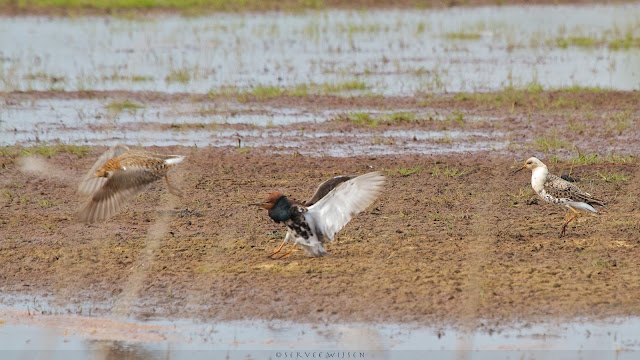
Vandaag zijn er weer veel steltlopers aanwezig, waaronder maar liefst 70! Kemphanen die regelmatig in een grote wolk opvliegen om 100 meter verder weer neer te strijken in de ondiepe plas. Misschien wel de mooiste weidevogels die er zijn, vooral de mannetjes met hun spectaculaire 'tooien' en toernooien om de gunst van de vrouwtjes, maar ze komen in ons land helaas steeds minder vaak voor. Ik schreef er al over in een eerdere post.
--------------------------------------------------------------------------------------------
Again there are a lot of wading birds today, among which 70! Ruffs that regularly fly up in a big cloud only to land again in a different spot not to far away. This might be one of the most beautiful wading birds around. Especially the males with their spectacular headdress which hold fighting tournaments to get in favor by the females. Unfortunately they are rare in our country nowadays. I wrote about them in an earlier post.
 |
| Kemphaan - Ruff - Philomachus pugnax |
 |
 |
 |
 |
En een paar Zwarte Ruiters. Zelden echt zwart als je ze in Nederland ziet, meestal zijn ze dan in winter- of rui/overgangskleed. In hun noordelijke broedgebieden zijn de mannen in broedkleed zwart met witte spikkels op de vleugels. Misschien dat ze vanwege de aanhoudende kou wat langer in ons land zijn blijven hangen en daarom inmiddels aardig geruid zijn en behoorlijk zwart wat mij betreft.
--------------------------------------------------------------------------------------------
A couple of Spotted Redshanks. When in our country they are seldom to be seen this black, which is the males summer plumage which they normally don't wear until they are at their northern breeding grounds in Scandinavia. Maybe they stayed in our country longer because of the ongoing cold weather and therefore have changed from winter to summer plumage already.
 |
| Zwarte Ruiter - Spotted Redshank - Tringa erythropus |
 |
 |
| Kleine plevier met zijn karakteristieke ring rond het oog - Little Ringed Plover with characteristic ring around the eye |
Greetzzzz, Servee
Geen van deze foto's mag zonder mijn schriftelijke toestemming worden gebruikt voor publicatie of welk ander doel dan ook. Een link naar deze pagina is uiteraard wel toegestaan. Neem voor meer informatie contact op via mijn website www.serveewijsen.com
-----------------
None of the contents or photos published here may be used for publication or any other purposes without my written permission. linking to this page is permitted. For more information on using these images please contact me through my website www.serveewijsen.com